Sunday, March 13, 2016

The Italian Air Campaign in East Africa I

“Pipistrelli” in the East Africa

 Pilots and groundcrew of No 3 Squadron, South African Air Force, chalk up their 101st enemy aircraft shot down on the fuselage of a captured Italian CR 42 fighter.
 
The Duke of Aosta


Throughout the campaign in East Africa, the Italian troops fought with resolution and courage. When the war began, the Italian forces were composed of 91,000 Italian nationals (of whom 7,000 were officers) belonging to the Army, Air Force and Revenue Guards. The colonial soldiers numbered around 200,000. They were equipped with 3,300 machine-guns; sixty-four medium tanks; thirty-nine light tanks; 126 armoured cars and trucks; 813 guns of different calibres but all dated; 325 aircraft of which only 244 were combat ready. In comparison, the British were outnumbered, but better armed and more mobile as they were mechanised. As we have seen, this was not a detail, but a major factor in the vast territories over which the conflict was fought.

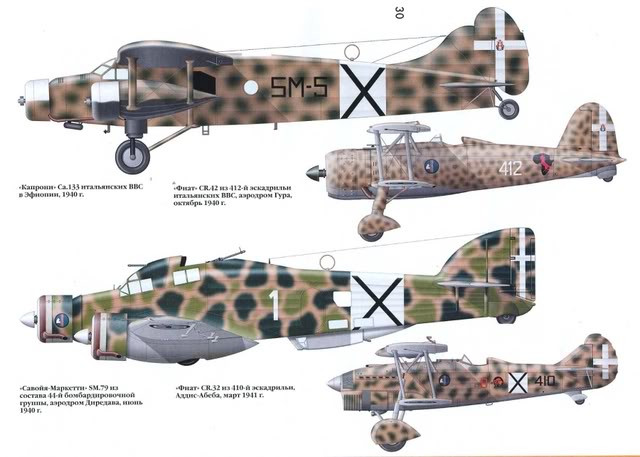
It had been an air war that had been dominated by the biplane fighter, the CR.32 and CR.42 and the Gloster Gladiator, but what of the aces, the men who had flown them? Some had seen combat in Spain and others were fresh to aerial dogfights. Undoubtedly, not only the Italian pilots, but the British and Commonwealth ones too, were supremely brave men, fighting over inhospitable terrain, often against hopeless odds. The following few paragraphs examine the careers and sometimes the deaths of some of the more successful Italian pilots. Omissions are purely incidental.

Luigi Baron was born in 1918 at Castelfranco Veneto; he was to serve with 412a Squadriglia, equipped with Fiat CR.42s. He ended the campaign as the second most successful of the Italian fighter pilots in the East Africa. A Gladiator of 237 Squadron was operating over Keren on 25 March 1941 and spotted a pair of CR.42s, but it was then attacked by a Hurricane of 1 SAAF Squadron. This squadron engaged CR.42s twice during the day, once in the morning when one was hit by Lt Irvine (possibly the 237 Squadron Gladiator and not a CR.42). In the afternoon Lt Robin Pare and Lt White encountered two CR.42s from 412 Squadriglia. They were at 15,000 ft. Pare shot one of them down, but the other escaped. The Italians admitted that one of the CR.42s was shot down; the one flown by Sergente Pietro Morlotti was killed. A second was later written off. Two other CR.42s were damaged that day, with both of the pilots being wounded. Two Hurricanes were also claimed by the CR.42s. Baron claimed one of the Hurricanes, but he was wounded in the leg and baled out. Baron remained in hospital for two years and was then repatriated to Italy. He arrived safely in Italy after a two-month voyage, and was given the Medaglia d’Argento al Valor Militare and the Medaglia di Bronzo al Valor Militare. He was also decorated with the German Iron Cross 2nd Class. He ended his war with twelve kills.

Carlo Canella was born on 22 June 1914 and was commissioned (in the Servizio Permanente Effettivo) on 28 October 1938. He too served with 412a Squadriglia. On 12 June 1940, he shot down a British Wellesley bomber over the Keren area. In the early hours of 16 October Flt Lt Mitchell (430 Flight), in a Vincent, attacked Tessenei airfield. He was followed back to Gedaref by a Ca 133, and so the Italians now knew where the aircraft were based. The Italians attacked the airfield at 0525, with an S.79 flown by Generale Piacentini leading in six CR.42s of the 412 Squadriglia; the pilots were Capitano Antonio Raffi, Tenente Visintini, Tenente Carlo Canella, Sergente Maggiore Lugi Baron, Scarselli and Tenente De Pauli. The fighters destroyed all eight Wellesleys of 47 Squadron’s detachment and two of 430 Flight’s Vincents. Canella ended the war with seven biplane victories. For his actions he was awarded two Medaglie d’Argento al Valor Militare and one Medaglia di Bronzo al Valor Militare.

Antonio GiardinĂ  served with the 410a Squadriglia, and flew a Fiat CR.32. At noon on 24 June 1940, four Blenheims of 39 Squadron and two of 11 Squadron hit Diredawa in flights of three. GiardinĂ  was up on a standing patrol. He dived out of the sun on the leading flight and attacked them, damaging all three of the aircraft. On 11 July 1940 a Blenheim of 8 Squadron, flown by Flg Off P.A. Nicholas (Aden), made a reconnaissance over Jijiga. The aircraft was intercepted by Sottotenente Veronese and Sergente Maggiore GiardinĂ , who attacked the bomber, claiming to have probably hit it.

On 15 March 1941 Hurricanes of 3 SAAF Squadron attacked Diredawa. The Hurricane pilots found three Fiat CR.32s of the 410 Squadriglia in the air. One of the CR.32 pilots, Sergente Maggiore GiardinĂ , had just begun an attack on a Ju86 also attacking the airfield, when he suddenly spotted a Hurricane approaching to attack him. Sottotenente Osvaldo Bartolozzi rushed to GiardinĂ ’s aid without checking his own tail, the next moment hearing an explosion and being hit in the face and neck by splinters. He immediately broke away and began turning with his attacker, avoiding two more bursts of fire. He landed with 188 holes in his aircraft, but no serious damage. GiardinĂ  fought on for several minutes, returning fire, and at last the Hurricane left. He was then able to land.

At 0700 on 28 March 1941, five CR.42s and two CR.32s from Gauani under the command of Tenente Franco De Micheli of the 413a Squadriglia made an attack on Jijiga airfield. In the first pass a Ju52/3m (No. 660), a Valentia (No. 264) and a Hartebeest were set on fire; two of the Ju52/3ms that were damaged in an attack on the 26th were also shot up again, as was a Leopard Moth of the Communication Squadron. The Italians had not found the fighter satellite strip, and two Hurricanes of 3 SAAF Squadron flown by Capt S. van Breda Theron and Lt Venter scrambled. Theron was no sooner in the air than his aircraft received a bullet in the cooling system (from an airfield defence Lewis gun, it was suspected); he went in to land again, but as he did so he was attacked by Sergente Maggiore GiardinĂ  in a CR.32. The Hurricane was set on fire and Theron was wounded in the leg. As soon as GiardinĂ  saw Theron leap out onto the wing, which he did the moment his Hurricane touched the ground, GiardinĂ  ceased firing. Venter was attacked by three Fiats and his aircraft was riddled with bullets, but he managed to shoot down one Fiat, which fell in flames and crashed. The pilot was Sottotenente Silvano.

GiardinĂ  was shifted to 412a Squadriglia and began flying CR.42s. On 2 July 1941 Sergente Maggiore Giuseppe Mottet and GiardinĂ  claimed one shared Vickers Wellesley of 47 Squadron, which was shot down over Gondar, the aircraft falling in flames. The pilot, Sgt Alexander George Brown, and his crew were all killed. Later in the war GiardinĂ  served with 300a Squadriglia in the night defence of Rome. He was to end the war with five biplane victories. GiardinĂ  was decorated with two Medaglie d’Argento al Valor Militare and one Medaglia di Bronzo al Valor Militare.

Giuseppe Mottet was born in Fontanemore (Aosta) on 12 September 1912. In 1937, he volunteered for the Spanish Civil War and was assigned to 20a Squadriglia, XXIII Gruppo ‘Asso Di Bastoni’, flying Fiat CR.32s. Mottet flew about ninety missions during his tour in Spain, primarily on escort flights to bombers and field protection sorties. In 1939 he received an order to transfer to the 411a Squadriglia in Africa Orientale Italiana (AOI, or Italian East Africa). He arrived at Addis Ababa on 30 August.

From 10 June 1940 to 27 November 1941 he flew many reconnaissance flights and strafing attacks, and was involved in dogfights. On 14 November 1940 he flew as Number Two in a section of two aircraft when they were involved in combat with four unknown enemy aircraft over Jimma airfield. Three of the aircraft were claimed shot down, and this was later confirmed.

On 9 April 1941, Giuseppe Mottet was engaged by Hurricanes over Gimma while defending the base flying a Fiat CR.32, together with another fighter. Capt Frost and Lt Hewitson of 3 SAAF Squadron shot him down. The aircraft was a write-off but Mottet was unhurt.

On 2 July 1941 Mottet and Sergente Maggiore Antonio GiardinĂ  claimed one shared Vickers Wellesley. This was a Wellesley of 47 Squadron, which was shot down over Gondar, the aircraft falling in flames. In a report from 411a Squadriglia on 11 August it was reported that he had flown 160 hours of combat missions from 22 August 1939 to date. On 15 October he was promoted to Maresciallo at Gondar. From 31 October, after the death of his CO, Tenente Malavolti, he was the only Italian fighter pilot in Italian East Africa. On 22 November 1941 the last CR.42 flown by Mottet was sent out and attacked British artillery at Kulkaber. Upon landing, he destroyed the CR.42 and joined the Italian troops, fighting until the surrender five days later. Giuseppe Mottet was decorated with the Medaglia d’Argento al Valor Militare.

Enzo Omiccioli was born in Fano on 1 June 1915. In the beginning of the East African campaign he was serving with 410a Squadriglia, equipped with Fiat CR.32s. On 15 June Omiccioli intercepted a Blenheim (39 Squadron) over Diredawa, but no result was claimed. In July Omiccioli was on a brief attachment to the 411a Squadriglia. On 11 July four Hawker Hartebeests of 40 SAAF Squadron made an attack around Moyale. There they encountered three Ca 133s, escorted by three CR.32s of the Squadriglia. The fighters attacked the South African aircraft, and Lt Neville Keith Rankin was last seen in a spin with one Fiat on the tail of his aircraft; he and his gunner, Air Sgt Dennis Haig Hughes, were both killed. Lt L.H.G. Shuttleworth’s aircraft was hit, but he made good his escape. The Italians reported meeting five aircraft, and claimed to have probably shot down two of them, one of these being claimed by Sergente Maggiore Omiccioli.

Omiccioli was loaned to the 412a Squadriglia, equipped with CR.42s. On 3 February six Gladiators from 1 SAAF Squadron flew into a new landing-strip called ‘Pretoria’, where they refuelled. They took off again at 1145 to strafe airfields in the Gondar area. A landing-site was spotted to the south of Azozo on which five Ca 133s were sitting. Another airfield was nearby, from which CR.42s were taking off. The Gladiators were attacked by the Fiats. In the combat Capt Brian Boyle and Capt Gerald Le Mesurier each claimed a Fiat shot down. The only loss sustained by the Italians in this combat was Sergente Maggiore Omiccioli, who was shot down and killed. He was posthumously awarded Italy’s highest decoration for valour, the Medaglia D’Oro al Valor Militare (Gold Medal). At the time of his death, he had a total of five victories, all of them claimed while flying biplanes.

Corrado Ricci was born in 1912, and he joined the Regia Aeronautica in 1931. After serving in Spain he served with the 410a Squadriglia, equipped with Fiat CR.32s. At 0800 on 1 August 1940, the two secret Italian landing-grounds at Chinele, near Diredawa, were discovered and strafed by two Blenheims. Six Blenheims each from 8 and 39 Squadrons, escorted by two Blenheim IVFs of 203 Squadron, were sent off to attack the fields in the afternoon. At 1500 the bombers approached at 16,000 ft and dived to 10,000 ft to bomb.

The Italian Air Campaign in East Africa II

Regia Aeronautica (Royal Air Force) in East Africa (Africa Orientale) 

Capitano Ricci, commanding officer of the 410a Squadriglia, had taken off in his CR.32 as the second wave of bombers approached, and he chased these. He later wrote:

I look around; nothing to see. But ... something is coming from the sunshine ... Here they are, six diving bombers. It seems to me they are heading towards our secret airfields. I hope they had been alerted! They are flying over Diredawa; I’ll chase them out of the town border. They hadn’t bombed the town, so they’re really heading to the airfields. They are going to pass at my side, at my same level, fast as a bolide [meteorite]! I attack the front section of three from the side, the other section still being to the rear. While I’m firing, I find myself in their trail; I shoot at the leader, then at the right wingman; the two aircraft seem to leave tiny trails of smoke, but I’m not sure of it. One of my machine-guns jams, but I don’t recharge it because I don’t want to lose aim. Tracer shells passed nearby my side, I hear shots behind me; I am attacked too. I evade with a large, barrel-shaped tonneau; while I’m upside down I can see the second section passing at my right side, slightly lower than me. At the end of the manoeuvre I’m at six of the left wingman, but in the meanwhile I recharged the jammed gun, so I shoot again, sharing my rounds to all three, while bombs are falling. First section is far ahead, the two aircraft I fired at are still smoking. ... I concentrate on the aiming: it’s the turn of the right wingman now. The gun jams again! I recharge it. All three aircraft leave a light trail of smoke, like the two of the first section. I shoot again ... the aircraft I’m shooting at seems to slow down ... is it an illusion? No, it is really slowing down: while the other two are going, it extracts the gun turret and begins to shoot at me. I fire again; the British pilot manoeuvres to prevent me to hide behind his tail. I discharge brief bursts ... I must slow down to not collide with him. We are at ten metres from ground; the British extracts the flaps and lands on the sand in a cloud of dust.

He had, in fact, shot down a Blenheim of 8 Squadron. At 0600 on 8 August Berbera airfield was attacked by two CR.32s and one CR.42 from 410a Squadriglia, based at Hargeisa, led by Capitano Ricci flying in one of the CR.32s. The Italian aircraft had taken off from Diredawa at 0500. Ricci later wrote:

I was the first to take off, with Tellurio at my wing; soon after started Cacciavillani and Komienz, but the first skipped on ground, and then stood with tail up: what could have happened to him? Komienz joined us. I checked my compass with a pocket light to keep the course. After half an hour of flight the light is coming, but we could not yet see Berbera; five minutes more: nothing again ... I again checked the chart; the course is right, but I have no reference point on the ground because it is so flat; I know that the wind is strong, and its direction change as the sun rise, but I can’t evaluate it. I continue a little bit on chance. At the end I decide to turn 90-degrees left; after a few minutes a sparkling ahead makes me happy: it’s the sea! I start a light dive, and I increase it as we are approaching, so we find us to fly grazing to the yellowish sand: it’s the only way to come unseen! I can see the town, it’s small, whitish; there’s a ship in the harbour. Here is the airfield: two dark aircraft, side by side, stand out. They are Gladiators. My wingmen close at me, and this bothers me; slowly, I gain speed and I put them away from me. We are skimming the ground and some small hills cover us to enemy’s sight; just a little bit ... Here we are! With a steep climb I gain 500 m height, then I dive on the fighter at left; while I’m aiming a man leaves it and falls headlong ... what a long-legged he is! I shoot: a strong wind disturbs my shoot, my rounds are on ground, but some hit the target. I pull hard, quite skimming the wing of the enemy aircraft; I hear behind my shoulders that Tellurio and Komienz are firing too. The anti-aircraft weapons awake; bluish tracer shells, shrapnel explosions; the ships fires like a volcano, the machine-guns in their nest at the airfield’s edge are shooting: the air is hot! A big turn: the other Gloster is burning, mine is not, but with a second burst I get it burning too. We can go! I take a snapshot with my old camera that I bring with me at every flight: I have to prove the results of the action. We go away, with a grazing flight. A sand column rise just in front of me; here another and other around: they are the British grenades. I climb to 200 m altitude: black burst around us, some other sand gush here and there, then all is over.

At the beginning of December he made an emergency crash-landing after the engine on his CR.32 had failed. After this incident Capitano Ricci was sent for a period of convalescence. Six Blenheims of 8 Squadron from Aden bombed Diredawa early on 9 March 1941, six CR.42s and a single monoplane being reported as seen on the ground, although only two or three fighters were actually present; the monoplane was a S.81, already damaged beyond repair, but retained as a decoy.

Three CR.32s of the 410a Squadriglia approached the bombers head on, and the leader, Capitano Ricci, turned sharply to attack the right-hand Blenheim. This manoeuvred to evade him, and Ricci found himself right next to another Blenheim, piloted by Sqn Ldr Hanlon. Ricci opened fire as it began to pull away from him, and saw his bullets exploding on the rear of the right-hand engine nacelle. Sqn Ldr Hanlon had to force-land on Perim Island during the homeward flight as a result of the damage sustained.

Capitano Ricci had been able to intercept the bombers and attack them before they had dropped their bombs. He recalled:

A morning I scramble with Puliti and I’m radio-guided to intercept two sections of three Blenheims each, which were going to bomb Diredawa. I think I could made only a single front attack, because, since they are faster than me, I could never reach them for a second pass; so, I decide to attack them from the rear to increase my possibilities. With a big turn I dive on the formation, which at a certain point is hidden from my sight by my wing; I fear to collide with them, but meanwhile I think that however they should take care to avoid me! Indeed I came very close to the right wingman, which suddenly veered away from the patrol and was soon attacked by Puliti, while I find myself right on the side of the leader, after having risked to hit its wing with my plane. I immediately start to fire, aiming at the right engine, but the slipstream shatters my aim, while the rudder dangerously pass me by; but a long, black smoke trail came from the engine, just while a piece tears off from the fuselage. I think to have got it, and I go to attack another alone one, that escapes me by diving. Here is a third one, it’s alone too: I attack it. He’s a courageous pilot: instead to evade, he challenges to me with beautiful turns; I’m surprised to see little smoke trails from its fuselage, but perhaps it’s the gunner that’s shooting at me. During the manoeuvres my weapons continue to jam while I’m shooting in tight turns, but at the end I find myself in a good advantage; the foe realises it and, with a good overturn, go in a vertical dive, then heads towards Dankalia while I’m pursue him, shooting, while it leaves me behind, more and more. He disappears, apparently undamaged. The ground observers, however, don’t see it pass: they spot only five while heading home. Sometime after, we knew that a Blenheim force-landed in the Tajura area, in the French Somaliland, but the crew should have been able to return to Arabia: perhaps they are those!

Ricci was allowed to return to Italy in April 1941 because he was suffering from appendicitis. He ended the war with five victories, all of them claimed while flying biplanes during the Spanish Civil War and the Second World War.

Arnoldo Soffritti was born on 5 April 1913 in Bondeno (Ferrara). He served with the 412a Squadriglia, equipped with Fiat CR.42s. On the afternoon of 29 January 1941, in a dogfight between 1 SAAF Squadron and 412a Squadriglia over Gura, Soffritti’s CR.42 was damaged. On the morning of 2 February 1941 a Lysander of 237 Squadron, flown by Flg Off M.A. Johnson, was on tactical reconnaissance, and the aircraft was claimed shot down by Soffritti. On 7 February, two Wellesleys from 47 Squadron made a reconnaissance from Barentu to Adi Ugri. They were intercepted by the 412a Squadriglia and both were shot down, one being claimed by Soffritti. On 19 March 1941, two Hurricanes of 1 SAAF Squadron were patrolling over the Keren area when they were attacked by three CR.42s, Maresciallo Soffritti claiming to have shot down one. Between 0710 and 0830 on 28 March 1941, Soffritti claimed to have shot down a Hurricane in the Ad Teclesan area, and in Eritrea on 4 April 1941, he claimed to have shot down a British bomber between 0730 and 0805. Soffritti was captured at Dessie on 26 April 1941, by which time he was credited with eight biplane victories, five probable, eleven destroyed on the ground. Soffritti won two Medaglie d’Argento al Valor Militare.

Alberto Veronese was a veteran from the Spanish Civil War, and in East Africa he served with 410a Squadriglia, equipped with Fiat CR.32s. On 11 July 1940 a Blenheim of 8 Squadron, flown by Flg Off P.A. Nicholas, was intercepted and attacked by Sottotenente Veronese and Sergente Maggiore GiardinĂ , who claimed to have probably hit it.

Veronese made a head-on attack against one of three Blenheims of 39 Squadron on 12 August 1940. He shot the aircraft down, but was wounded in the encounter. Six days later, Sottotenente Veronese and Sergente Maggiore Volpe of 410a Squadriglia shot down a Blenheim from 8 Squadron flown by Sgt Gay to the north-west of Laferug. Veronese and Sergente Maggiore Athos Tieghi shared a kill on 12 September when they tackled Lt Edward George Armstrong DFC of 11 SAAF Squadron in his Fairey Battle over Shashamanna.

The last French Martin 167F in Aden was on a reconnaissance mission over Diredawa on 16 December when it was attacked by a pair of CR.32s of 410a Squadriglia. Veronese closed on the tail of the Martin and opened fire, but the speed of the French aircraft was too much for the slower biplane. Veronese had climbed too high and was hit by anoxia, and he had to land and be taken to the sick bay.

Soon afterwards, Veronese was promoted to tenente, and on 4 February 1941 he and Tenente Folcherio attacked a pair of Blenheims from Aden of 203 Squadron flown by Sqn Ldr J.M.N. Pike and Flt Lt Gethin. Both of the Blenheims were hit and had to crash-land. Makale was attacked again on the morning of 18 February by another pair of Blenheims from the same squadron. Veronese shot down Sqn Ldr A.L.H. Solano and then chased Sqn Ldr Scott, damaging his aircraft so badly that it had to crash-land when it got back to Aden.

Seven Hurricanes of 1 SAAF Squadron strafed Makale on 23 February. Maj L.A. Wilmot, leading the lower section of three Hurricanes, was shot down by Veronese, but then Lt Andrew Duncan shot him down. He parachuted to safety, slightly wounded. Effectively, his wounds put him out of the combat for good in East Africa. He had become the most successful pilot of 410a Squadriglia, with six kills and two shared kills. He was evacuated to Italy, and after the surrender in 1943 he joined up with the Italian Co-Belligerent Air Force and served in 356a Squadriglia. Veronese was killed on 4 September 1944 by German anti-aircraft fire in Greece. During the war he was decorated with two Medaglie d’Argento al Valor Militare.

Mario Visintini was born in Parenzo d’Istria on 26 April 1913. He was to become the top Italian biplane fighter ace. In January 1940 he was promoted to tenente for war merits. After serving in Spain he was transferred to East Africa on 5 April 1940. Initially he was posted to 413a Squadriglia. Before the start of the war in June 1940 he was transferred to the 412a Squadriglia in Eritrea. His first kill of the war took place on 14 June 1940, when he shot down a Wellesley of 14 Squadron flown by Plt Off Reginald Patrick Blenner Plunkett. He claimed a second Wellesley on 3 July over Decamere, when Flg Off Samuel Gustav Soderholm was killed. On 12 July he shot down another Wellesley, this time flown by Sgt Frederick (Freddy) Nelson of 47 Squadron. On 29 July he was decorated with the Medaglia d’Argento al Valor Militare.

On 1 September Visintini shared a claim with another pilot when they shot down a Wellesley of 14 Squadron flown by Sgt Norris. On 30 September, Sqn Ldr George Justin Bush in a Blenheim of 45 Squadron was victim to Visintini. During the morning of 9 February Visintini took part, together with four other pilots from 412a Squadriglia, in an attack on Agordat and its satellite airfield. Sixteen aircraft were claimed shared destroyed on the ground, including five Hurricanes, five Hawker biplanes, two Gladiators, two Wellesleys, one Valentia and one Westland Lysander.

On 11 February Visintini shot down a Hurricane over Keren. This claim was probably made in combat with Hurricanes from 1 SAAF Squadron, which had eleven aircraft on patrols over the area during the day. Later in the day Visintini took off to fly back to guide other pilots home. It seems, however, that during the flight he was blown off course by high winds, and while descending through clouds he crashed into the side of Mount Nefasit and was instantly killed. He was posthumously awarded the Medaglia D’Oro al Valor Militare for his outstanding combat record. According to Italian War Bulletin No. 252 of 14 February 1941, he was credited with seventeen confirmed victories in Italian East Africa. The document attached to his Medaglia D’Oro states fifty combats, sixteen destroyed and thirty-two shared destroyed. At the time of his death, Visintini had seventeen victories, all of them claimed while flying biplane fighters.

What of French Somaliland? After the fall of France in 1940, as we have seen, French Somaliland declared its loyalty to Vichy France. The colony remained loyal to the Vichy regime throughout the East African campaign, but tried to stay out of the conflict. By December 1942, with the Italians defeated and the colony isolated, it was alone. Free French and Allied forces recaptured the colony, and ultimately a battalion from Djibouti was involved in the liberation of France in 1944.

B Flight had returned to Aiscia after the fall of Gondar to patrol the border with French Somaliland. On 11 December 1941, Lt Gazzard took off in a Mohawk to chase a French Potez 631 that had just buzzed the runway. Gazzard shot at the Potez and saw it billowing smoke, but it escaped him. Perhaps this was the last aerial combat of the war over the former Italian East Africa.

It had been a campaign that had stretched the resources, the minds and the bodies of British and Commonwealth troops; it had also seen a more than creditable display by the Italians, particularly in the air. No. 47 Squadron was dispatched to Egypt to become a reconnaissance squadron, while 3 SAAF headed back to South Africa, where its Mohawks would be used to trained pilots for the desert war. As for the Ansons and Ju86s, they would struggle on for a time until they were finally too worn out and were replaced with Marylands and Bristol Beauforts.